
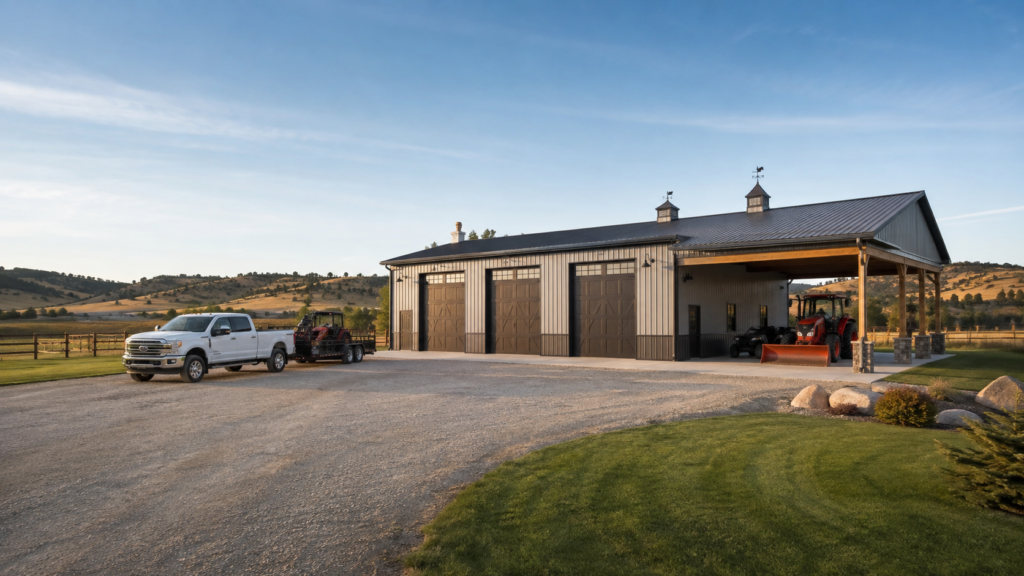
Most property owners are good at making things work.
A trailer becomes extra storage. A tarp covers equipment for one more season. A corner of the garage turns into a workshop. Tools get stacked wherever there is room. Vehicles are moved around to make space for something else. One temporary solution leads to another, and before long, the property is functioning around the lack of proper space.
At first, these fixes make sense. They are fast, inexpensive, and easy to justify. But over time, temporary solutions can become frustrating, inefficient, and costly.
For many property owners across Washington, Oregon, and Idaho, the decision to build a shop, garage, agricultural building, or post-frame structure often comes after years of working around the same problem.
The building is not just about adding space. It is about solving the issue properly.
Temporary Storage Usually Becomes a Long-Term Problem
Most people do not set out to create a messy or inefficient property. It usually happens slowly.
A few seasonal items get stored in one area. Equipment gets parked outside because there is no covered space. Project materials get tucked along a fence line. A trailer becomes a catch-all. The garage becomes too full to use for vehicles.
These small adjustments can work for a while, but they rarely support long-term function.
In the Northwest, weather makes this even more important. Rain, snow, wind, moisture, and seasonal temperature swings can wear down equipment, vehicles, tools, and materials when they are not properly protected.
What seems like a simple storage issue can eventually become a maintenance issue, a workflow issue, and an expense issue.
A Proper Building Creates Order
One of the biggest benefits of adding a post-frame building is the order it can bring to a property.
A well-planned shop or garage gives everything a place. Vehicles can be protected. Tools can be stored properly. Equipment can be accessed more easily. Work areas can be separated from storage areas. Seasonal items no longer have to be moved every time something else needs to be used.
This kind of order changes how a property functions day to day.
Instead of spending time moving things around, covering equipment, or searching for tools, property owners can use their space more efficiently.
For homeowners, hobbyists, business owners, and agricultural property owners, that daily function matters.
The Right Structure Can Protect What You Already Own
Many property owners think of a new building as a major investment, but it is also a way to protect existing investments.
Vehicles, tractors, side-by-sides, trailers, campers, tools, machinery, inventory, and work materials all cost money. Leaving them exposed to the elements or stored in overcrowded spaces can shorten their lifespan and create avoidable repairs.
A post-frame building can help reduce that exposure.
In areas like Coeur d’Alene, Sandpoint, Yakima, Pasco, and rural communities throughout Washington, Oregon, and Idaho, property owners often deal with a wide range of seasonal conditions. A building designed for the local climate can provide protection through hot summers, wet seasons, freezing temperatures, and winter weather.
That protection can make a meaningful difference over time.
Function Should Be Designed Around Real Life
A good building is not just a box with doors.
It should be designed around how the property is actually used. That includes vehicle access, equipment movement, storage needs, lighting, door placement, work zones, ventilation, and future growth.
For example, a property owner who works on vehicles may need higher ceilings, larger doors, better lighting, and space around each bay. Someone storing recreational equipment may need wide access and flexible storage. A small business owner may need organized inventory space, loading access, and room to grow.
The right design depends on the real purpose of the building.
This is why planning conversations matter. A structure should support the owner’s life, business, hobbies, or property needs instead of creating new limitations.
There Comes a Point When Building Makes More Sense
Not every property needs a new structure right away.
But there is usually a point where temporary fixes stop helping. When the same storage problem keeps coming back, equipment is left outside, projects are harder to complete, or the property feels harder to manage than it should, it may be time to consider a more permanent solution.
A post-frame building can create room, protection, flexibility, and long-term value.
It can also make a property easier to enjoy.
When the land functions better, the owner can spend less time managing the mess and more time using the space for what it was meant to support.
Final Thoughts
Temporary fixes can work for a season, but they are rarely the best long-term answer.
For property owners in Washington, Oregon, and Idaho, a thoughtfully designed post-frame building can solve problems that tarps, trailers, crowded garages, and makeshift storage areas cannot.
At Quality Structures One, every project starts with understanding what the property needs and how the structure will be used over time. Whether it is a shop, garage, barn, agricultural building, or custom post-frame structure, the goal is to build something that brings order, protection, and lasting function to the property.